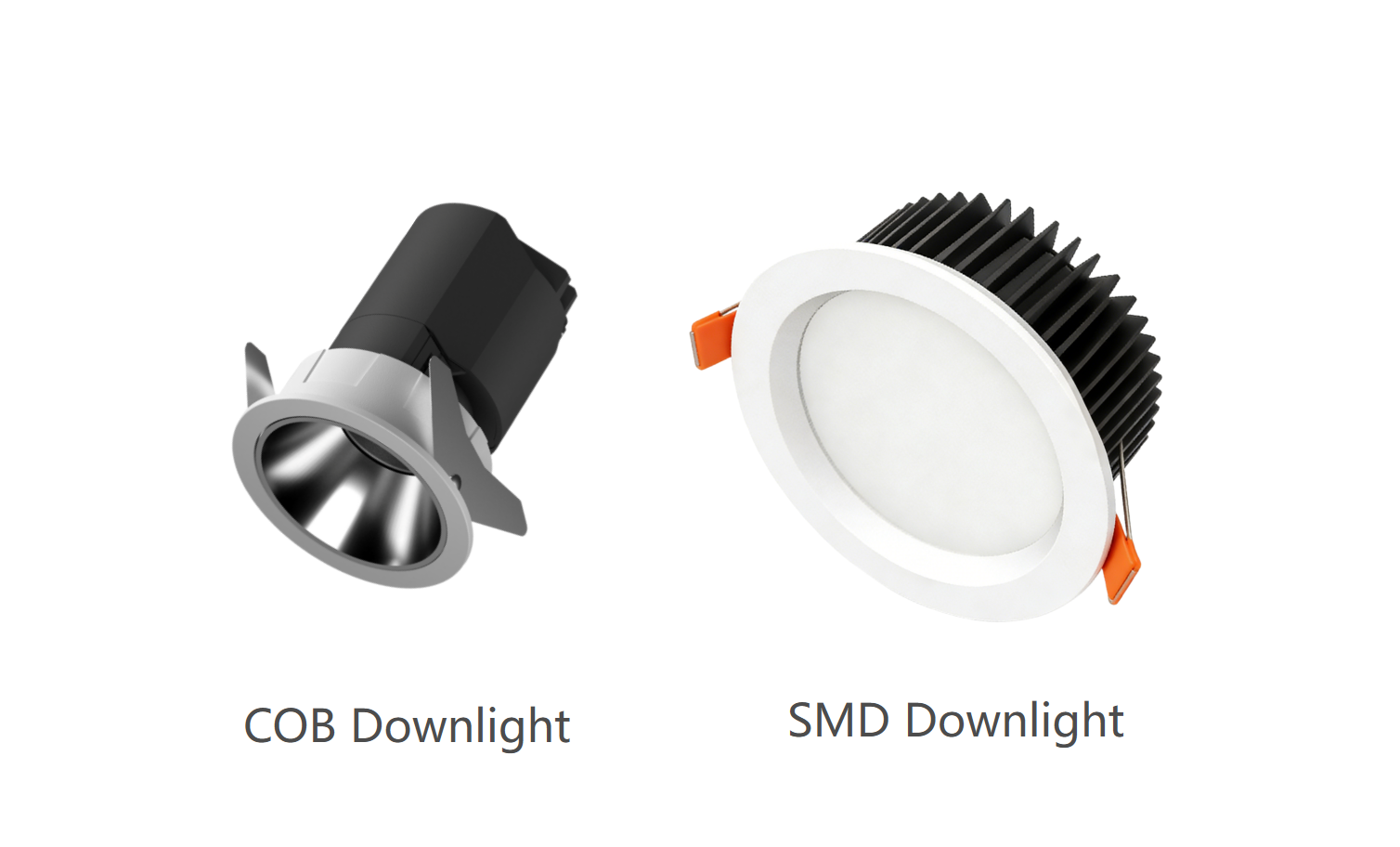
COB Downlight VS SMD Downlight: Comprehensive Comparison and Analysis of Advantages and Disadvantages
COB (Chip-on-board) downlights and SMD (surface-mounted device) downlights represent the predominant LED downlight types currently available on the market, exhibiting significant differences in structural design, optical performance, heat dissipation efficiency, and cost maintenance. The following detailed comparison examines multiple dimensions to assist you in selecting the most suitable product based on your specific requirements.
Core structural differences:
| Features | COB Downlight | SMD Downlight |
|---|---|---|
Light Source Structure | Multiple bare LED chips are directly encapsulated on a single substrate, forming a unified light-emitting surface | Multiple independently packaged SMD LEDs (such as 2835, 5050 etc.) are soldered onto the PCB board |
Light Emission Mode | Surface light source, visible light but cannot see lamp, no obvious particulate sensation | Point light source array with visible independent LEDs may produce a granular appearance and shadow |
| Heat Conduction Path | Chip→substrate→heat sink (three-stage heat transfer), low thermal resistance (typically < 6℃/W) | Chip→thermal conductive paste→chip holder→solder joint→PCB→heat sink (four-stage path),high thermal resistance (8-12℃/W) |
Luminous Area Density | Highly effective (>95%), a single 30mm COB can replace approximately 40pcs SMD LEDs | Moderate (50-70%), with gaps between the LEDs |
Optical performance comparison
COB downlight's Advantage:
1.Excellent light efficiency uniformity: no obvious light spots, dark areas, or "star effect," with natural and smooth light transitions.
2.High color rendering index: Mainstream products are CRI ≥90/95, with R9 value (saturated red color rendering) typically ≥90, ensuring more authentic color reproduction.
3.Good glare control: A single light-emitting surface combined with optical lenses or optical reflector can effectively reduce glare, resulting in superior eye protection performance.
4.Precise beam angle: typically 15-60 degrees, suitable for accent lighting and directional lighting applications
SMD downlight's Advantage:
1.Flexible brightness adjustment: Diverse brightness requirements can be achieved by increasing or decreasing the number of LEDs or selecting different LED specifications.
2.Wide beam angle: Capable of achieving wide angles (120°), suitable for various general lighting scenarios.
3.High light output efficiency: The LED is directly exposed without secondary optics, resulting in minimal light obstruction and clean, transparent light emission.
4.Low height of lamp: The lamp body is generally of low height, making it suitable for scenarios with limited ceiling space.
Comparison of Heat Dissipation and Reliability
COB Downlight:
1.Advantages: Low thermal resistance, high heat dissipation efficiency, lower chip junction temperature, slow optical degradation, and longer lifespan (typically>50,000 hours).
2.Disadvantages: High heat concentration, requiring more sophisticated heat sink design to prevent localized overheating.
SMD Downlight:
1.Advantages: Heat is distributed across multiple LEDs, resulting in a relatively simple PCB heat dissipation design.
2.Disadvantages: Higher thermal resistance may lead to more noticeable light degradation over prolonged use, and the overall lifespan is slightly shorter than that of COB (typically 40,000–50,000 hours).
Cost and Maintenance Comparison
| Item | COB Downlight | SMD Downlight |
|---|---|---|
| Initial cost | Higher,core technologies are complex with high heat dissipation requirements | Lower,production process is mature, significant advantages in large-scale production |
Maintenance cost | Higher,A single chip failure may necessitate replacement of the entire COB | Lower,the faulty LED can be replaced individually, offering more flexible maintenance. |
| Power Adapter | Higher requirements,requires stable current control,avoid local overheating | High adaptability,compatible with multiple drive power supplies, demonstrating excellent versatility |
Dimming Compatibility | Some products may experience dimming flickering issues and require a dedicated dimmer | More stable dimming performance and broader compatibility |
Application scenario differences
COB downlight is more suitable for:
1.High-end commercial spaces (such as museums, art galleries, and luxury stores) – require high color rendering accuracy and light uniformity.
2.Key illumination areas (e.g., office desks, display cabinets, and artwork lighting) – require precise light beams and glare-free effects.
3.High-ceilinged spaces — characterized by concentrated luminosity, strong penetration, and superior lighting effects
4.Areas requiring soft and comfortable lighting such as family living rooms and bedrooms — enhancing spatial sophistication
SMD downlight is more suitable for:
1.Large-scale base lighting (e.g., shopping malls, supermarkets, factories) – High cost-effectiveness with uniform ambient illumination.
2.Budget-constrained projects – Significant cost advantages, ideal for large-scale installations.
3.High-maintenance environments – Allows individual replacement of faulty LEDs to reduce maintenance costs.
Summary of advantages and disadvantages
COB Downlight's Core advantages and disadvantages:
Advantages:
✅ Uniform light distribution with no graininess, providing excellent visual experience
✅ High color rendering index for true color reproduction
✅ High heat dissipation efficiency, slow light decay, and long service life
✅ Excellent glare control with superior eye protection performance
✅ Compact structure with minimalist and sophisticated appearance
Disadvantages:
❌ High initial cost
❌ High maintenance costs; a single chip failure may require complete replacement
❌ High height of downlight in most cases, making it unsuitable for projects with limited ceiling space.
❌ Higher requirements for heat dissipation design and power supply quality
SMD Downlight's Core advantages and disadvantages:
Advantages:
✅ Significant cost advantage, suitable for large-scale application
✅ Flexible maintenance with individual replacement of faulty LEDs
✅ Wide brightness and beam angle
✅ Excellent dimming compatibility with multiple control methods
Disadvantages:
❌ Poor light efficiency uniformity, which may result in graininess and shadows
❌ The color rendering index is typically lower than that of COB (mainstream range: 80-90)
❌ High thermal resistance leads to relatively significant light degradation with prolonged use
❌ High risk of visual glare, requiring additional diffusion treatment
How to Choose?
1.For premium lighting performance: Choose COB downlights, ideal for spaces requiring high color accuracy and uniform illumination.
2.For budget-conscious installations or large-scale projects: Choose SMD downlights for better cost-effectiveness and lower maintenance costs.
3.For accent lighting or directional illumination: COB downlights excel with precise beam angles.
4.For everyday home lighting: Select based on personal preferences and budget—COB downlights convey sophistication while SMD downlights provide practical value.
If you require our professional team to provide customized selection recommendations and technical specifications (including beam angle, color rendering index, power range, and size range) based on your specific application scenarios (e.g., commercial spaces, home living rooms/bedrooms, display cabinets) and budget, please feel free to contact us.